



Even as the overall economy added 117,000 jobs in July, dialing back the official U.S. unemployment rate to 9.1 percent, nobody’s grandmother is ready to whip out the fancy cashews instead of that dish of plain old mixed nuts when the company arrives. On the heels of an acrimonious debt ceiling mêlée in Congress, S&P’s historic downgrade of the U.S. government’s credit rating, and last Thursday’s 512 point drop in the Dow Jones Industrial Average—the biggest one day drop since December 2008—lots and lots of peanuts appear to be in America’s future.
But the news isn’t entirely distasteful. Data from insideARM’s ARM Barometer, a quarterly survey of collection agencies, debt buyers, collection law firms, and credit grantors showed that many ARM companies in the outsourced business services sector of the U.S. economy added jobs in the second quarter of 2011.
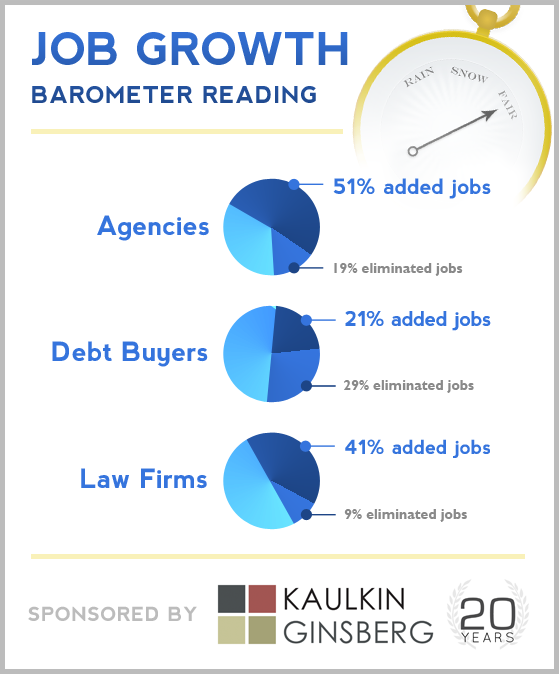
While net employment gains among asset buyers were offset by layoffs, collection agencies and debt collection law firms both increased their payrolls. According to survey respondents for the Summer 2011 Barometer sponsored by Kaulkin Ginsberg Company, 51 percent of collection agencies and 41 percent of collection law firms grew their employee rosters between April and June of this year.
The significance of these numbers is tripartite.
First, more collectors should boost service providers’ recovery performance, meaning a greater number of outstanding receivables are being converted to cash and injected into the broader U.S. economy.
Second, more ARM industry jobs mean more jobs—period. A greater number people working in cities like Minneapolis, Atlanta, Buffalo, Phoenix, Milwaukee, and St. Louis helps to improve not just the national unemployment picture, but local economies too.
Third, this data serves as an important tool in opposing the negative images often ascribed to ARM companies. From the misguided notion that recessionary periods are a boon for debt collectors to slipshod reporting common in many media reports about the collection industry that associate complaints about debt collectors with actual FDCPA violations or that tie any collection activity—a legitimate phone call or legal dunning notice—to abuse and harassment.
But a tool is only useful if you use it. How will you help build the reputation of the ARM industry today?
Michael Klozotsky is the managing editor of insideARM.com. He’s not a statistician, but he knows enough of “the maths” to say that even when the “dreaded debt collection industry” adds jobs, a few more American families can eat, learn, play, and live a little better.
![the word regulation in a stylized dictionary [Image by creator from ]](/media/images/Credit_Report_Disputes.max-80x80.png)
![Cover image for New Agent Onboarding Manuals resource [Image by creator from insideARM]](/media/images/New_Agent_Onboarding_Manuals.max-80x80_3iYA1XV.png)


![[Image by creator from ]](/media/images/Finvi_Tech_Trends_Whitepaper.max-80x80.png)
![[Image by creator from ]](/media/images/Collections_Staffing_Full_Cover_Thumbnail.max-80x80.jpg)
![Report cover reads One Conversation Multiple Channels AI-powered Multichannel Outreach from Skit.ai [Image by creator from ]](/media/images/Skit.ai_Landing_Page__Whitepaper_.max-80x80.png)
![[Image by creator from ]](/media/images/paper-collections_triggers_1_1.max-80x80.png)
![Report cover reads Bad Debt Rising New ebook Finvi [Image by creator from ]](/media/images/Finvi_Bad_Debt_Rising_WP.max-80x80.png)
![Report cover reads Seizing the Opportunity in Uncertain Times: The Third-Party Collections Industry in 2023 by TransUnion, prepared by datos insights [Image by creator from ]](/media/images/TU_Survey_Report_12-23_Cover.max-80x80.png)
![[Image by creator from ]](/media/images/Skit_Banner_.max-80x80.jpg)
![Webinar graphic reads RA Compliance Corner - Internal Controls: When and how to Effectively Use Them 6-15-24 2pm ET [Image by creator from ]](/media/images/RA_Web2_6.12.24_Landing_Page.max-80x80.png)
![Webinar graphic reads Help Wanted: Predictive, Collaborative and Intelligent Contact Data April 25 at 3pm et by TransUnion [Image by creator from ]](/media/images/Landing_Page_2_KAmAKW1.max-80x80.png)
![Webinar graphic reads Multi-Channel AI: Improve Contacts & Increase Revenue Compliantly April 4 at 2pm et [Image by creator from ]](/media/images/Skit.ai_InsideARM_Landing_Page_1200x627.max-80x80.png)
![Streamline Your Collections Process with Voice AI [Image by creator from ]](/media/images/Streamline_Your_Collections_Process_with_Voice.max-80x80.png)
![How to Connect with Today’s Digital Consumer [Image by creator Editor from insideARM]](/media/images/finvi_webinar_thumbnail.max-80x80.png)
![Customizable or Configurable? Webinar [Image by creator Editor from insideARM]](/media/images/Landing_Page_2.max-80x80.png)
![How to Launch an Omnichannel Collection Strategy [Image by creator Neustar from insideARM]](/media/images/omnichannel-webinar.max-80x80.png)
![Breaking Down the CFPB's Opinion on Convenience Fees [Image by creator Editor from insideARM]](/media/images/2022-11-convieniance-fees-webinar.max-80x80.png)